
Safety Hub
Safety Hub
Designed to showcase Toyota’s best in class safety features and initiatives.
Designed to showcase Toyota’s best in class safety features and initiatives.
Lead UX/UI Designer
Lead UX/UI Designer
Oct. 2022
Oct. 2022
Feb. 2023
Feb. 2023
Background
As the world’s leading car manufacturer, safety is a critical brand pillar for Toyota. However, their commitment to pioneering advanced vehicle safety technology and innovation isn’t strongly reflected on their website.
As the world’s leading car manufacturer, safety is a critical brand pillar for Toyota. However, their commitment to pioneering advanced vehicle safety technology and innovation isn’t strongly reflected on their website.
Challenge
Toyota's safety content is scattered across two separate experiences. Information is difficult to find, lacks clarity, and fails to inform users about Toyota's commitment to safety as the world’s leading car manufacturer.
Toyota's safety content is scattered across two separate experiences. Information is difficult to find, lacks clarity, and fails to inform users about Toyota's commitment to safety as the world’s leading car manufacturer.
Opportunity
Craft a seamless experience that unites existing safety content, helping both shoppers and owners explore safety features and technology and quickly find model-specific safety capabilities.
Craft a seamless experience that unites existing safety content, helping both shoppers and owners explore safety features and technology and quickly find model-specific safety capabilities.
Outcome
36.5%
increase in average monthly page visits over the first 6 months.
36.5%
increase in average monthly page visits over the first 6 months.
9th
most-visited page of all 20+ owners resource pages.
9th
most-visited page of all 20+ owners resource pages.
42.2%
increase in average monthly account logins.
42.2%
increase in average monthly account logins.
32.6%
increase in average daily VIN entries.
32.6%
increase in average daily VIN entries.
Understanding the Problem
Understanding the Problem
Toyota's shopping and ownership experiences have historically lived in separate digital ecosystems, leading to inconsistency and fragmentation. Consolidating these into one digital presence creates efficiencies across design, development, and organization, while keeping users within the Toyota.com environment rather than navigating away. Our safety experience, with several other Toyota Owners pages, was to be migrated to Toyota.com.
Toyota's shopping and ownership experiences have historically lived in separate digital ecosystems, leading to inconsistency and fragmentation. Consolidating these into one digital presence creates efficiencies across design, development, and organization, while keeping users within the Toyota.com environment rather than navigating away. Our safety experience, with several other Toyota Owners pages, was to be migrated to Toyota.com.

Heuristic Analysis
Heuristic Analysis
Toyota has multiple safety pages, Toyota Safety Sense (TSS), showcasing their active safety technology, and Toyota For Families (TFF), focused on family safety and car seat installation. TSS exists across both the main and Owners sites, while TFF lives exclusively on the Owners site, where users manage vehicles and accounts. Audits of both surfaced several issues.
Toyota has multiple safety pages, Toyota Safety Sense (TSS), showcasing their active safety technology, and Toyota For Families (TFF), focused on family safety and car seat installation. TSS exists across both the main and Owners sites, while TFF lives exclusively on the Owners site, where users manage vehicles and accounts. Audits of both surfaced several issues.
There are extremely limited entry points to the TSS experience on Toyota.com.
Static visuals fail to contextualize complex features.
TSS only surfaces the newest feature pack, with no details around the other available versions.
Can only view safety features for the newest model years.
Owners TSS page has no content - it only redirects users back to the Toyota.com.
TFF mission is unclear, content is thin, and its most critical resource is buried.

There are extremely limited entry points to the TSS experience on Toyota.com.
Static visuals fail to contextualize complex features.
TSS only surfaces the newest feature pack, with no details around the other available versions.
Can only view safety features for the newest model years.
Owners TSS page has no content - it only redirects users back to the Toyota.com.
TFF mission is unclear, content is thin, and its most critical resource is buried.
There are extremely limited entry points to the TSS experience on Toyota.com.
Static visuals fail to contextualize complex features.
TSS only surfaces the newest feature pack, with no details around the other available versions.
Can only view safety features for the newest model years.
Owners TSS page has no content - it only redirects users back to the Toyota.com.
TFF mission is unclear, content is thin, and its most critical resource is buried.
Analytics Findings
Analytics Findings
As an isolated, but intentional experience, analytics revealed that the existing TSS page on Toyota.com has mostly direct, externally inbound traffic, while the rest of the pages received even lower traffic and engagement.
As an isolated, but intentional experience, analytics revealed that the existing TSS page on Toyota.com has mostly direct, externally inbound traffic, while the rest of the pages received even lower traffic and engagement.
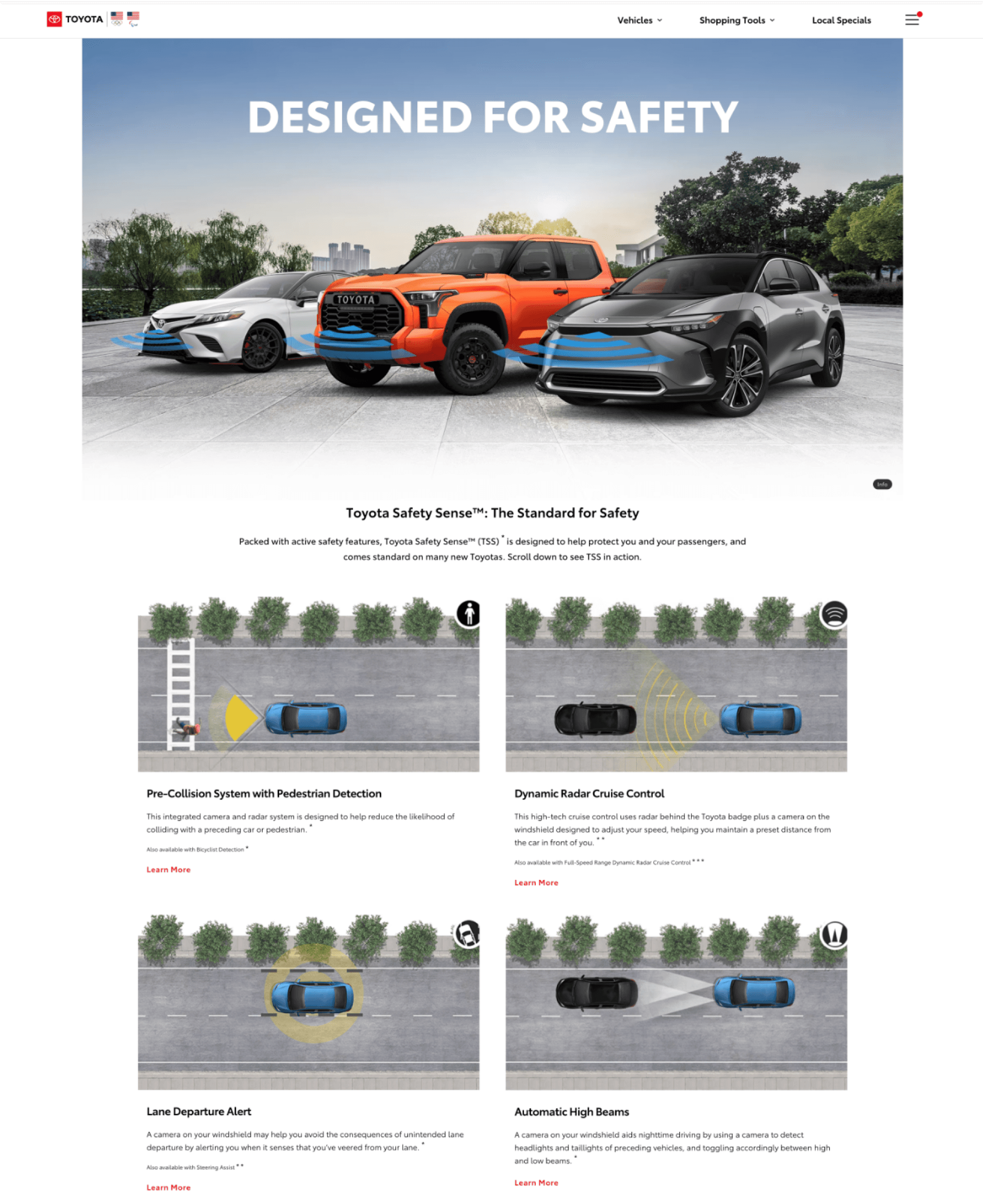
1/3
of users visit TSS from other TCOM pages; most traffic is direct, externally inbound.
1/3
of users view TSS info on a model landing page, and only 1% go to the TSS from there.
25%
of users engage with the modals, videos, and extra layers of content on the page.
75%
of users immediately bounce from the TSS page.
5%
of users engage with shopping tools (Search Inventory, Build and Price, Payment Estimator) after visiting TSS.
1/3
1/3
visit the TSS page from other Toyota.com pages; most traffic is direct, externally inbound.
1/3
1/3
view the TSS information on a model landing page, and only 1% go to the TSS page from there.
25%
25%
engage with the modals, videos, and extra layers of content on the page.
75%
75%
immediately bounce from the TSS page.
5%
5%
engage with shopping tools (Search Inventory, Build and Price, Payment Estimator) after visiting the TSS page.

Toyota.com
Toyota.com
Toyota.com
TSS
TSS
TSS

1/3
of users visit TSS from other TCOM pages; most traffic is direct, externally inbound.
1/3
of users view TSS info on a model landing page, and only 1% go to the TSS from there.
25%
of users engage with the modals, videos, and extra layers of content on the page.
75%
of users immediately bounce from the TSS page.
5%
of users engage with shopping tools (Search Inventory, Build and Price, Payment Estimator) after visiting TSS.
Toyota Owners
Toyota Owners
TFF + TSS
TFF + TSS
Toyota Owners
TFF + TSS


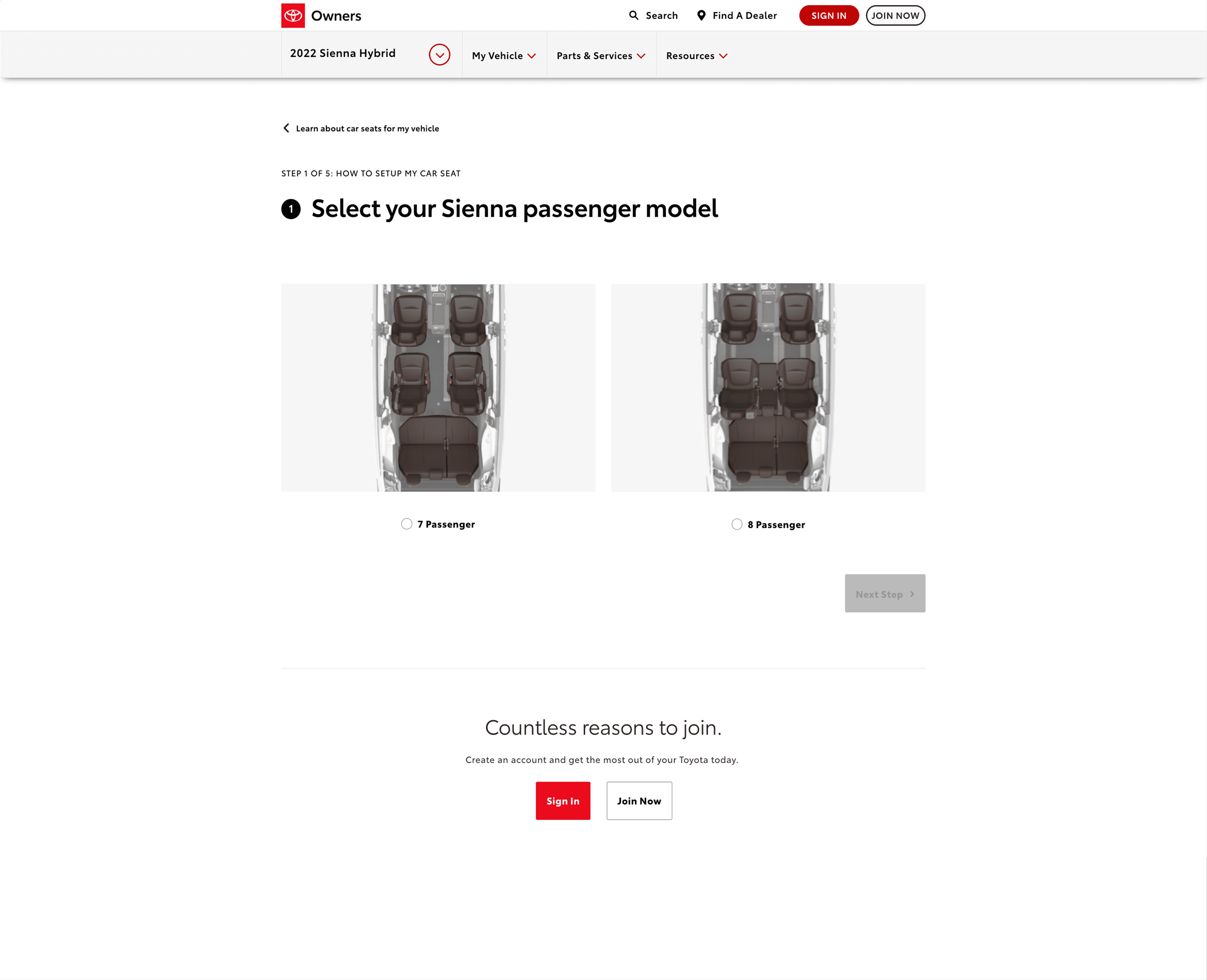
20%
of Toyota models currently have Toyota For Families car seat installation guides available.
2.6%
of users enter the TFF car seat installation guide.
<1%
of users complete the entire TFF car seat installation guide experience.
20%
of Toyota models currently have Toyota For Families car seat installation guides available.
2.6%
of users enter the TFF car seat installation guide.
<1%
of users complete the entire TFF car seat installation guide experience.
2.6%
of users enter the TFF car seat installation guide.
20%
of Toyota models currently have Toyota For Families car seat installation guides available.
<1%
of users complete the entire TFF car seat installation guide experience.
Competitive Analysis
Competitive Analysis
After analyzing several competitive brands, I discovered that almost all have a central hub for safety-related content and technology. Key patterns and takeaways included:
After analyzing several competitive brands, I discovered that almost all have a central hub for safety-related content and technology. Key patterns and takeaways included:
Integrating storytelling elements and real testimonials to gain user trust and evoke emotion.
Simplifying complex safety technology through conveying features with 3D animations.
Adding personalization by allowing owners to view available safety features for their vehicle.
Integrating storytelling elements and real testimonials to gain user trust and evoke emotion.
Simplifying complex safety technology through conveying features with 3D animations.
Adding personalization by allowing owners to view available safety features for their vehicle.
Integrating storytelling elements and real testimonials to gain user trust and evoke emotion.
Simplifying complex safety technology through conveying features with 3D animations.
Adding personalization by allowing owners to view available safety features for their vehicle.

User Observations
User Observations
Given our analytics findings, we understood that users were likely experiencing some frustration. We conducted informal, unmoderated walkthroughs of both existing safety experiences to identify exact areas that needed improvement. A small group of 5 participants (2 of them owners) was used to gather the following insights and feedback:
Given our analytics findings, we understood that users were likely experiencing some frustration. We conducted informal, unmoderated walkthroughs of both existing safety experiences to identify exact areas that needed improvement. A small group of 5 participants (2 of them owners) was used to gather the following insights and feedback:
Pain Points We Identified
It’s difficult to locate the safety content and I can’t find anything for my own vehicle.
It’s not easy to understand which features come with all TSS systems.
I don't understand the automotive jargon used to explain the safety features.
I would rather see safety features before convenience features because those are more important to me.
User Needs
Clear entry points in the global navigation and a way to view their model year’s specific safety features.
A way to see which features are available within each TSS system.
New visuals and animations that clearly demonstrate each TSS feature.
Prioritize and highlight content that is most important when considering purchase.
Pain Points We Identified
It’s difficult to locate the safety content and I can’t find anything for my own vehicle.
It’s not easy to understand which features come with all TSS systems.
I don't understand the automotive jargon used to explain the safety features.
I would rather see safety features before convenience features because those are more important to me.
User Needs
Clear entry points in the global navigation and a way to view their model year’s specific safety features.
A way to see which features are available within each TSS system.
New visuals and animations that clearly demonstrate each TSS feature.
Prioritize and highlight content that is most important when considering purchase.
Pain Points We Identified
It’s difficult to locate the safety content and I can’t find anything for my own vehicle.
It’s not easy to understand which features come with all TSS systems.
I don't understand the automotive jargon used to explain the safety features.
I would rather see safety features before convenience features because those are more important to me.
User Needs
Clear entry points in the global navigation and a way to view their model year’s specific safety features.
A way to see which features are available within each TSS system.
New visuals and animations that clearly demonstrate each TSS feature.
Prioritize and highlight content that is most important when considering purchase.
Defining User and Business Goals
Defining User and Business Goals
Defining User and Business Goals
To identify goals that consider both Toyota as a business and Toyota shoppers and owners, I mapped out goals for each, and any additional technical considerations. The overlapping areas of this diagram identified the project goals, which were taken into account during the design ideation phase. These findings helped shape our problem statement for our two key personas - active vehicle shoppers (~60% of users) and current owners seeking out service and support (~35% of users).
To identify goals that consider both Toyota as a business as well as Toyota shoppers and owners, I mapped out objectives and technical considerations for each. Overlapping areas of this diagram identified overarching goals, which were taken into account during the design ideation. These findings helped shape our problem statement for our key personas - active vehicle shoppers (~60% of users) and current owners seeking out service and support (~35% of users).
To identify goals that consider both Toyota as a business as well as Toyota shoppers and owners, I mapped out objectives and technical considerations for each. Overlapping areas of this diagram identified overarching goals, which were taken into account during the design ideation. These findings helped shape our problem statement for our key personas - active vehicle shoppers (~60% of users) and current owners seeking out service and support (~35% of users).

Defining User and Business Goals
To identify goals that consider both Toyota as a business as well as Toyota shoppers and owners, I mapped out objectives and technical considerations for each. Overlapping areas of this diagram identified overarching goals, which were taken into account during the design ideation. These findings helped shape our problem statement for our key personas - active vehicle shoppers (~60% of users) and current owners seeking out service and support (~35% of users).
Ideating a Solution
Now that we had a better idea of our product vision, we created two low-fidelity wireframe directions with slightly different approaches.
Safety Sense


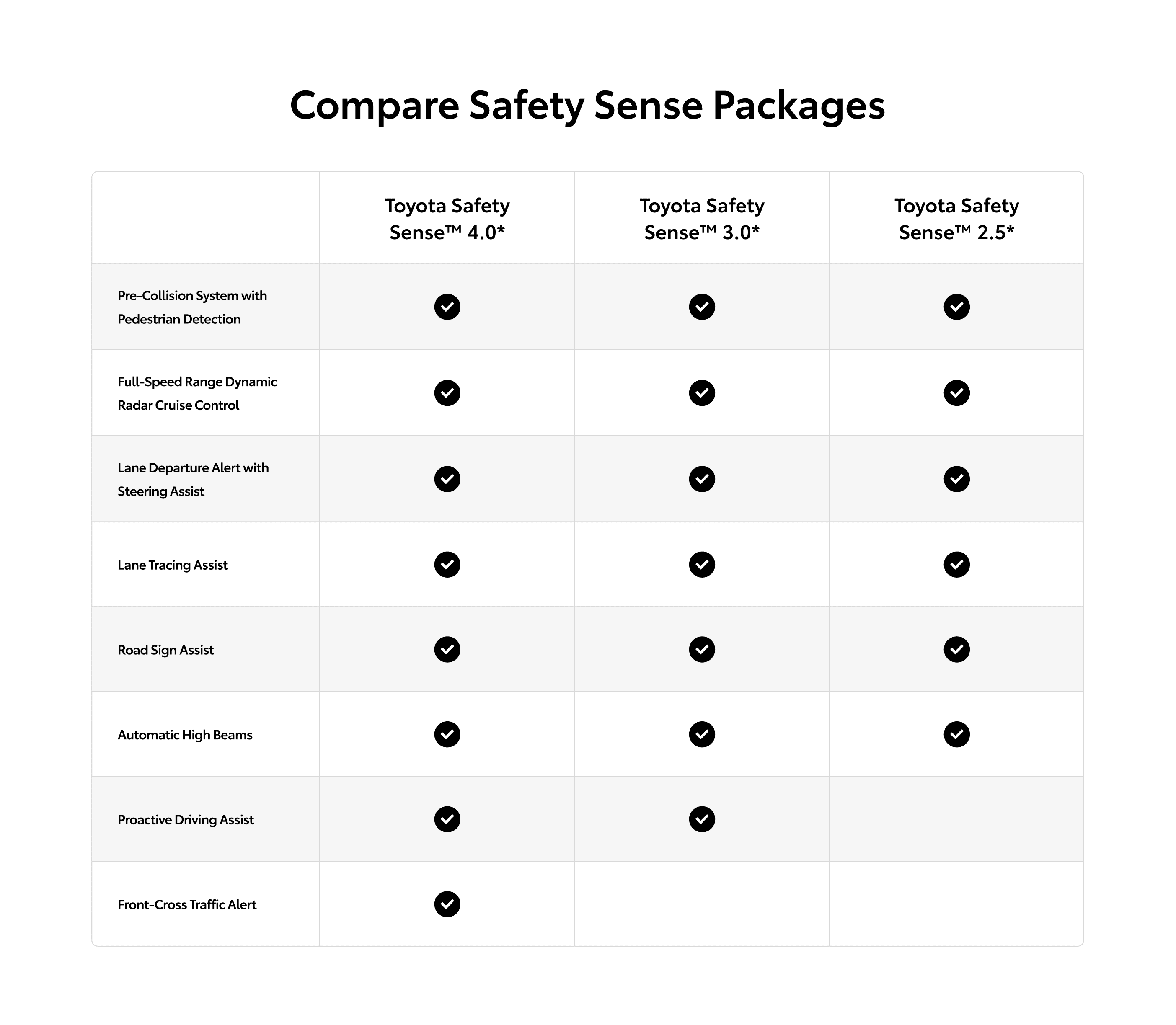


This approach prioritizes TSS for prospective buyers, leading with the newest 4.0 system through animated feature highlights and a full video demo overlay. TFF, given its limited vehicle eligibility, is featured on the vehicle dashboard and within owner's manuals until it becomes available on more vehicles. Owners can access their vehicle-specific TSS features and specs through those same touchpoints.
Safety Sense
This approach prioritizes TSS for prospective buyers, leading with the newest 4.0 system through animated feature highlights and a full video demo overlay. TFF, given its limited vehicle eligibility, is featured on the vehicle dashboard and within owner's manuals until it becomes available on more vehicles. Owners can access their vehicle-specific TSS features and specs through those same touchpoints.
Safety Hub
Recommendation


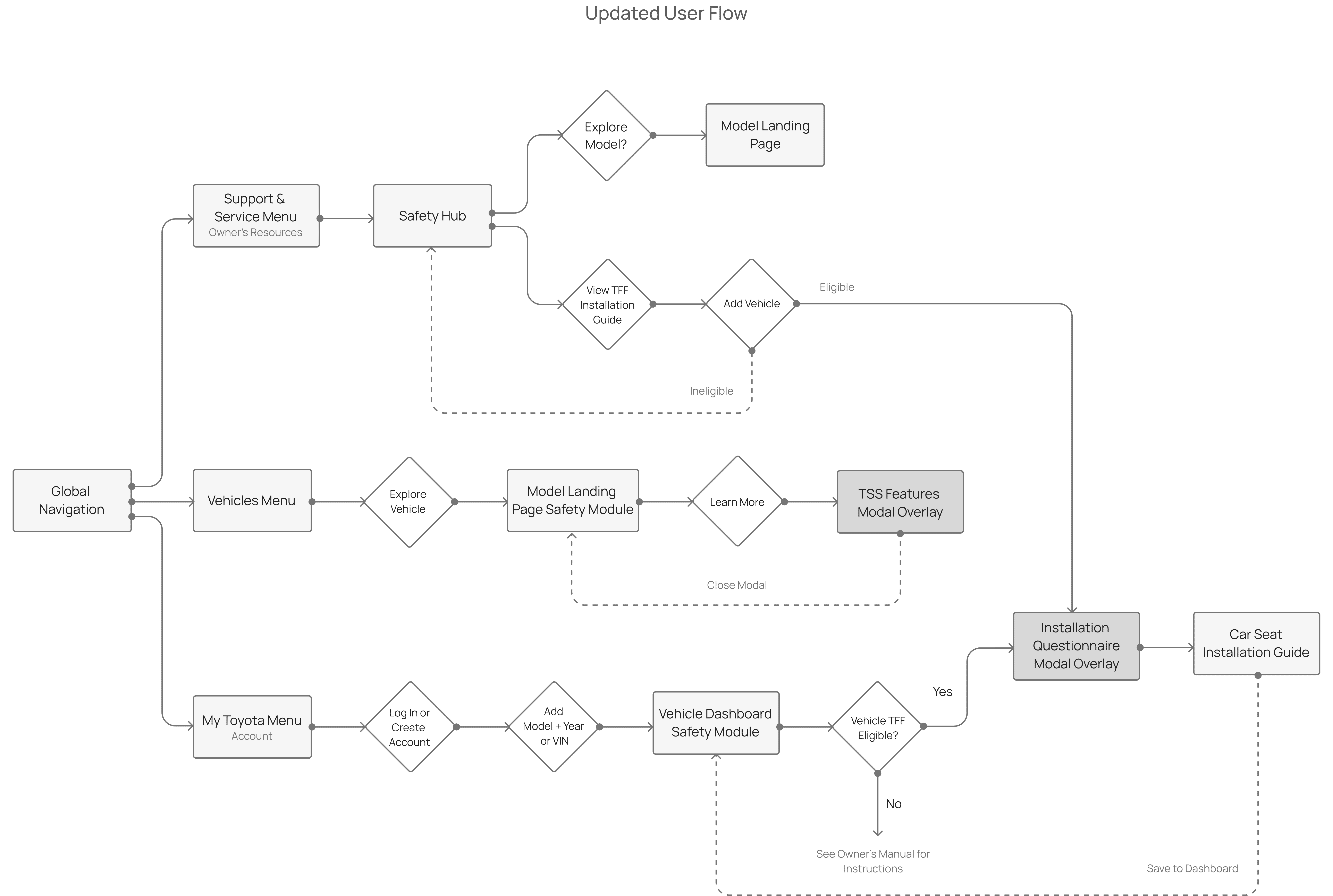
This approach serves both shoppers and owners through a balanced, high-level overview of Toyota's full safety ecosystem, including technology, initiatives, and storytelling beyond TSS alone. Shoppers can explore which models carry which TSS system, while owners can access vehicle-specific features through their dashboard and owner's manual. TFF installation guides are available directly from the page by selecting an eligible vehicle.
Safety Hub
Recommendation
This approach serves both shoppers and owners through a balanced, high-level overview of Toyota's full safety ecosystem, including technology, initiatives, and storytelling beyond TSS alone. Shoppers can explore which models carry which TSS system, while owners can access vehicle-specific features through their dashboard and owner's manual. TFF installation guides are available directly from the page by selecting an eligible vehicle.
Usability Testing
Five returning participants evaluated both wireframe directions against the same tasks: comparing different TSS package features and locating the TSS for a specific model. Sessions were conducted as moderated with open discussion, with participants explaining what they liked and potential areas of improvement as they navigated each direction.
Primary emphasis on TSS 4.0 for the Safety Sense Overview direction made TSS package comparison slightly more difficult.
Users liked animations in Safety Sense Overview, but time to scroll outweighed the benefit versus a single component approach.
Grade walk component hierarchy in Safety Hub and a more personalized approach for owners allowed users to quickly find a vehicle of interest by visiting an MLP or the vehicle dashboard.
The TFF callout on Safety Hub had one user interested in adding a vehicle and viewing what the car seat installation experience looked like.
Primary emphasis on TSS 4.0 for the Safety Sense Overview direction made TSS package comparison slightly more difficult.
Users liked animations in Safety Sense Overview, but time to scroll outweighed the benefit versus a single component approach.
Grade walk component hierarchy in Safety Hub and a more personalized approach for owners allowed users to quickly find a vehicle of interest by visiting an MLP or the vehicle dashboard.
The TFF callout on Safety Hub had one user interested in adding a vehicle and viewing what the car seat installation experience looked like.
Ideating a Solution
Now that we had a better idea of our product vision, we created two low-fidelity wireframe directions with slightly different approaches.
Now that we had a better idea of our product vision, we created two low-fidelity wireframe directions with slightly different approaches.
Safety Hub
Recommendation
Safety Sense
This approach prioritizes TSS for prospective buyers, leading with the newest 4.0 system through animated feature highlights and a full video demo overlay. TFF, given its limited vehicle eligibility, is featured on the vehicle dashboard and within owner's manuals until it becomes available on more vehicles. Owners can access their vehicle-specific TSS features and specs through those same touchpoints.
Safety Hub
Recommendation
This approach serves both shoppers and owners through a balanced, high-level overview of Toyota's full safety ecosystem, including technology, initiatives, and storytelling beyond TSS alone. Shoppers can explore which models carry which TSS system, while owners can access vehicle-specific features through their dashboard and owner's manual. TFF installation guides are available directly from the page by selecting an eligible vehicle.
Primary emphasis on TSS 4.0 for the Safety Sense Overview direction made TSS package comparison slightly more difficult.
Users liked animations in Safety Sense Overview, but time to scroll outweighed the benefit versus a single component approach.
Grade walk component hierarchy in Safety Hub and a more personalized approach for owners allowed users to quickly find a vehicle of interest by visiting an MLP or the vehicle dashboard.
The TFF callout on Safety Hub had one user interested in adding a vehicle and viewing what the car seat installation experience looked like.
Usability Testing
Five returning participants evaluated both wireframe directions against the same tasks: comparing different TSS package features and locating the TSS for a specific model. Sessions were conducted as moderated with open discussion, with participants explaining what they liked and potential areas of improvement as they navigated each direction.
Final Interface
Final Interface
We received alignment with our recommended direction, Safety Hub. After feedback from users, the internal team, client and stakeholders, we refined and iterated, and completed visual design using existing components within our design system. We then annotated and accounted for all possible use cases, handed off to dev and completed QA before launching.
We received alignment with our recommended direction, Safety Hub. After feedback from users, the internal team, client and stakeholders, we refined and iterated, and completed visual design using existing components within our design system. We then annotated and accounted for all possible use cases, handed off to dev and completed QA before launching.
Safety Hub
Final User Interface


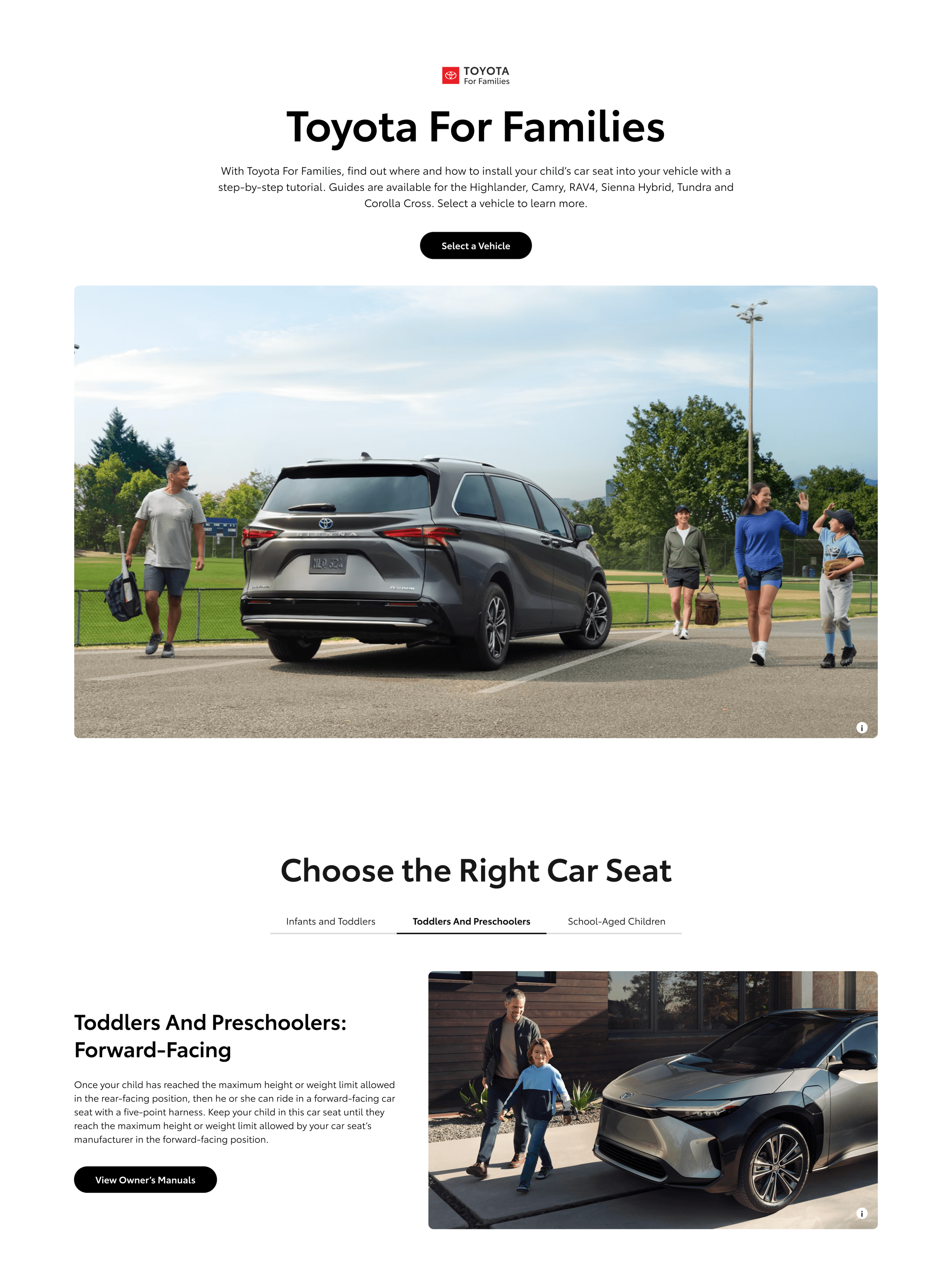


Our final iteration of Safety Hub showcases all existing TSS systems with helpful animation demos. Visitors can browse available safety packages and standard features across the newest model lineup, or add their own vehicle (all models from 1996 to current) to view its specific safety system, other features, and TFF guide (if available).
Dashboard Components
Final User Interface


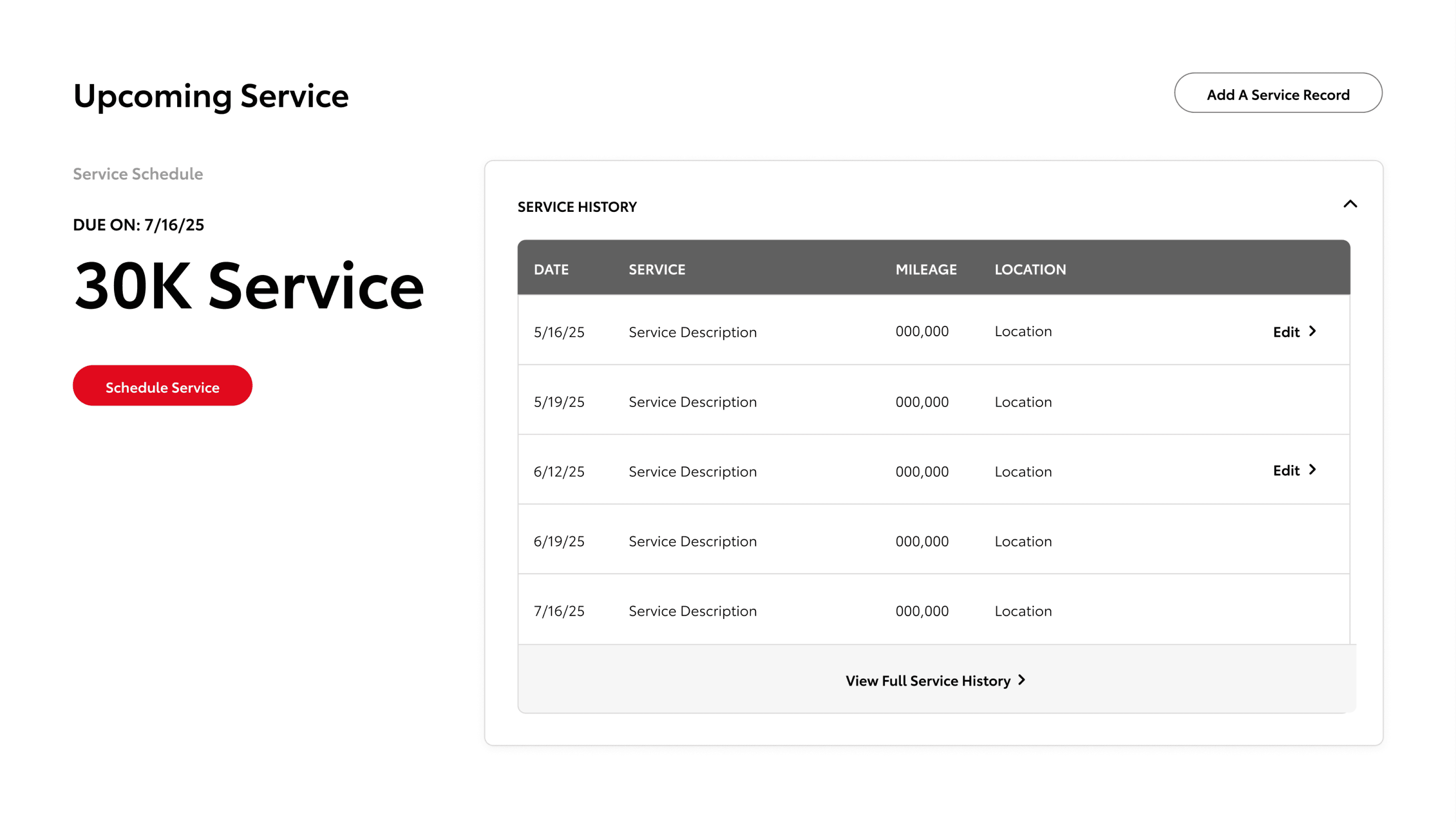


The Vehicle Dashboard includes a component to highlight the vehicle’s TSS package, as well as the option to open an overlay with animations and descriptions for each feature. For eligible vehicles, a TFF component will launch the car seat installation questionnaire, and the completed guide can be saved to their dashboard.
Safety Hub
Final User Interface
Our final iteration of Safety Hub showcases all existing TSS systems with helpful animation demos. Visitors can browse available safety packages and standard features across the newest model lineup, or add their own vehicle (all models from 1996 to current) to view its specific safety system, other features, and TFF guide (if available).
Vehicle Dashboard Components
Final User Interface
The Vehicle Dashboard includes a component to highlight the vehicle’s TSS package, as well as the option to open an overlay with animations and descriptions for each feature. For eligible vehicles, a TFF component will launch the car seat installation questionnaire, and the completed guide can be saved to their dashboard.
Dashboard Components
The Vehicle Dashboard includes a component to highlight the vehicle’s TSS package, as well as the option to open an overlay with animations and descriptions for each feature. For eligible vehicles, a TFF component will launch the car seat installation questionnaire, and the completed guide can be saved to their dashboard.
Safety Hub
Our final iteration of Safety Hub showcases all existing TSS systems with helpful animation demos. Visitors can browse available safety packages and standard features across the newest model lineup, or add their own vehicle (all models from 1996 to current) to view its specific safety system, other features, and TFF guide (if available).
Delivery
Delivery
Every part of the design was built responsively, with existing components (and a few new ones where needed) and thoroughly annotated for handoff — ensuring it could scale across our Toyota ecosystem.
Every part of the design was built responsively, with existing components (and a few new ones where needed) and thoroughly annotated for handoff — ensuring it could scale across our Toyota ecosystem.
Components

Vehicle Dashboard Components
Final User Interface
The Vehicle Dashboard includes a component to highlight the vehicle’s TSS package, as well as the option to open an overlay with animations and descriptions for each feature. For eligible vehicles, a TFF component will launch the car seat installation guide and completion can be saved to their dashboard.
Page Annotations

Page Annotations
Components
Takeaways and Next Steps
Takeaways and Next Steps
This project demanded heavy cross-collaboration between multiple Toyota stakeholders, and making their voices felt heard, but we were able to deliver an MVP that exceeded expectations and moved us closer to a unified ecosystem between shopping and ownership.
In retrospect, rather than relying on low-fi A/B wireframe testing to gauge preferences among a handful of users, we could have invested in more qualitative feedback from a larger sample size to dig into the “why” behind user decisions. Working with a limited testing budget means leaning heavily on analytics and informal feedback, which can still drive meaningful decisions.
Looking ahead, one of the clearest opportunities we have is to increase account creation and vehicle adds so we can connect more owners to their Toyota, available resources, and maintenance tools, unlocking the full value of our site.
This project demanded heavy cross-collaboration between multiple Toyota stakeholders, and making their voices felt heard, but we were able to deliver an MVP that exceeded expectations and moved us closer to a unified ecosystem between shopping and ownership.
In retrospect, rather than relying on low-fi A/B wireframe testing to gauge preferences among a handful of users, we could have invested in more qualitative feedback from a larger sample size to dig into the “why” behind user decisions. Working with a limited testing budget means leaning heavily on analytics and informal feedback, which can still drive meaningful decisions.
Looking ahead, one of the clearest opportunities we have is to increase account creation and vehicle adds so we can connect more owners to their Toyota, available resources, and maintenance tools, unlocking the full value of our site.